

26 - Social Sciences & Education (GOLD)

About Dr. Namrata Sharma

Namrata Sharma is faculty at the State University of New York, USA, and an international education consultant. She is an expert with the United Nations Harmony with Nature Knowledge Network and has served on the boards of several professional organizations across Europe, India, and the USA. She also currently serves on the Education Advisory Council (EAC) at the International Baccalaureate (IB).
Dr. Sharma’s research interests focus on International and Comparative Education, Global Citizenship Education, and Sustainability Education. In particular, her research draws linkages between teaching the UNESCO-led initiatives of Education for Sustainable Development (ESD) and Global Citizenship Education (GCE). She has authored several journal articles and books, including Education for Sustainability and Global Citizenship (2025). For more information, visit DrNamrataSharma.com
“Namrata Sharma highlights the need for world citizenship. Her many bibliographic references to publications and websites make the book an important tool for developing positive approaches to education through dialogic learning.”
René Wadlow, President of the Association of World Citizens
“Namrata Sharma brilliantly addresses the ethical dilemmas at the heart of teaching GCE as transformative knowledge, showcasing her expertise and visionary approach. In this insightful book, she expands on value-creating global citizenship education as a framework for cultivating constructive change-makers, providing groundbreaking, practical solutions for educators and policymakers, complementing GCE and ESD.”
Massimiliano Tarozzi, Professor, University of Bologna, Italy, and UNESCO Chair on Global Citizenship Education in Higher Education
“This inspiring new book is what global education needs now. Drawing on diverse global sources and informed by key research, policy, and practice, as well as an ethical, justice, and planetary perspective, it explores the future of global education. It will be of immense value to policymakers, researchers, teacher educators, and practitioners.”
Liam Wegimont, Executive Director, GENE – Global Education Network Europe
“Environmental crises are a major threat to humanity. Are we ready to tackle these crises? Does education serve the purpose of making the world a better place to live? This book offers a fresh perspective from selected Eastern and other indigenous viewpoints, which many have ignored, to develop an intercultural approach to curricula for education for sustainable development. It offers practical examples of selected worldwide initiatives for sustainable development and the implications for teaching and learning.”
Wendy Yee Mei Tien, Principal, Soka International School Malaysia, Malaysia
“Humankind must recognize knowledge created by people worldwide, Indigenous as well as mainstream voices. Dr. Namrata Sharma offers unique global knowledge links – theoretical and practical – for teachers, scholars, policymakers, and interested readers to learn about meaningful, humanist, value-creating, earth-centered, global/planetary citizenship education.”
Tania Ramalho, Professor of Education, Emerita - SUNY Oswego, USA
“Sharma's volume is an important addition to the growing number of works on sustainability and global citizenship. The focus on value creation and the work of the Earth Charter provides an important added dimension to the literature in the field.”
Douglas Bourn, Professor of Development Education, University College London, UK
About the Book
How do we address teaching for sustainability and global citizenship for social-ecological justice based on alternative paradigms?
This book addresses the implications of the environmental crisis on formal, non-formal and informal education from a human rights position. The author introduces a pedagogical approach called “value-creating global citizenship education” from a study of selected worldwide integrated perspectives, building on the United Nations (UN) sustainable development goals, and beyond. There are six themes for the practice of this approach. The focus within each of these six themes is to develop resilience and hope through engaged relationships between learners and their natural and social environments. Examples are drawn from Indigenous knowledge, diverse ecological worldviews and practices including the Earth Charter, the Soka Amazon Institute, and the UN Harmony with Nature Knowledge Network that promotes Earth Jurisprudence. The book offers practical solutions for planetary citizenship for educators and policymakers, including teaching and curriculum guidelines that can be used to integrate intercultural perspectives and develop a global outlook. (This book will be Open Access on the book’s webpage on Bloomsbury Collections starting August 20, 2026.)
An Excerpt From the Book

Chapter 8, pp. 189-190:
Conclusion: A Human Rights-Based Approach to Leaving No One Behind
This book has considered some worldwide examples of practical steps and commitments to implement sustainability, social and ecological justice within education across formal and non-formal education settings. These examples are relevant to key stakeholders at national and international levels to achieve the UN SDGs and the Paris Climate Agreement. Further, as discussed in this chapter, the Dublin Declaration is a clarion call to work together “in solidarity with peoples globally” toward 2050, and beyond.
Ikeda, in his 2020 annual peace proposal, endorses one of the key principles behind the SDGs of “leaving no one behind” (UN 2022). He notes that Makiguchi, in his 1903 work, Jinsei Chirigaku (The Geography of Human Life), had the foresight to see the limitations of military, political, and economic competition in “our tendency to view the world as solely the site of competition for survival” and instead called for a “humanitarian or humane modes of competition, in which one benefits oneself while working for the sake of others” (Makiguchi 1983: 2–7). In his proposal, Ikeda also states that “Toda’s determination was that no people, whatever their nationality, would ever find their rights and interests trampled upon, a vision he termed ‘global nationalism’ (Jpn: chikyu minzokushugi)” (Ikeda 2020: 14). Elsewhere, in addressing the issue of climate change, Ikeda shares the need to revisit Makiguchi’s notion of humanitarian competition to solve the global environmental crises, referring to it as “a vision of an international order in which the world’s diverse states strive to positively influence each other, to coexist and flourish together rather than pursuing narrowly defined national interests at each other’s expense” (Ikeda 2008: 14).
It is particularly relevant to ensure that the UN’s goal of leave no one behind considers such broader understandings of competition, collaboration, development, and progress from perspectives that support mutual growth and happiness and works for all people, especially for vulnerable groups, such as migrant populations (Laverack 2018) and children who lack access to basic health, welfare, and education (Kharas et al. 2019). Value-creating global citizenship education as a pedagogical tool can help engage marginalized voices and perspectives within a dominant Western neoliberal discourse on education for sustainable development and global citizenship, with the aim to usher in hope and take strategic steps forward (for more information, see Sharma 2020, https://drnamratasharma.com ).


Special Honors: Best in Large Press
The Emperor of Gladness
Ocean Vuong
The instant New York Times bestseller • Oprah’s Book Club Pick • Named a Best Book of 2025 by TIME, The New Yorker, Harper's Bazaar, USA Today, NPR, People, Christian Science Monitor, Scientific American, and Kirkus Reviews • Longlisted for the 2026 Andrew Carnegie Medal for Excellence
“Stunning . . . A heartfelt and powerful examination of those living on the fringes of society, and the unique challenges they face to survive and thrive.” —Oprah Winfrey
Ocean Vuong returns with a bighearted novel about chosen family, unexpected friendship, and the stories we tell ourselves in order to survive
The hardest thing in the world is to live only once…
One late summer evening in the post-industrial town of East Gladness, Connecticut, nineteen-year-old Hai stands on the edge of a bridge in pelting rain, ready to jump, when he hears someone shout across the river. The voice belongs to Grazina, an elderly widow succumbing to dementia, who convinces him to take another path. Bereft and out of options, he quickly becomes her caretaker. Over the course of the year, the unlikely pair develops a life-altering bond, one built on empathy, spiritual reckoning, and heartbreak, with the power to transform Hai’s relationship to himself, his family, and a community on the brink.
Following the cycles of history, memory, and time, The Emperor of Gladness shows the profound ways in which love, labor, and loneliness form the bedrock of American life. At its heart is a brave epic about what it means to exist on the fringes of society and to reckon with the wounds that haunt our collective soul. Hallmarks of Ocean Vuong’s writing—formal innovation, syntactic dexterity, and the ability to twin grit with grace through tenderness—are on full display in this story of loss, hope, and how far we would go to possess one of life’s most fleeting mercies: a second chance.

Special Honors: Best in Small Press
School Seasons xSELeratED: A Year of Community and Collective Growth for Educators
Leigh reagan Alley, Heather Lageman, Walter McKenzie
Teach with the seasons. Lead with what matters.
If you've ever wished that Social-Emotional Learning (SEL), culture, and instructional routines would work together—not as competing demands but as mutually reinforcing practices—this is your map and your companion. School Seasons xSELeratED offers month-by-month playbooks aligned to our xSELeratED Schools Framework, pairing ready-to-use micro-moves with gentle, human-centered rituals that protect energy and build momentum.
Written by three seasoned practitioners—a Wholeness-Centered Leader, a Community Builder, and a Systems Thinker—this guide weaves together heart, relationship, and structure into sustainable practices that honor both the work and the people doing it.
Inside you'll find:
-
75+ micro-moves designed for 5–10 minutes—small enough to fit into tight schedules, powerful enough to shift culture
-
Low-prep openings, transitions, and closures that feel human, not scripted
-
Reflection protocols, PLC prompts, and leadership look-fors that travel across grade spans and content areas
-
Monthly themes that mirror the emotional arc of the school year: belonging in August, trust in October, curiosity in April, celebration in May
-
Planning templates and conversation starters you can use tomorrow
The xSELeratED Schools Framework:
-
Understanding Myself: Recognizing my emotions, thoughts, identities, and patterns—and how they influence my choices, learning, and relationships
-
Nurturing Myself: Caring for my body, mind, and spirit with regulation, boundaries, and restorative habits that sustain energy and purpose
-
Understanding Others: Perceiving others' perspectives, contexts, and cues with curiosity, empathy, and cultural humility
-
Nurturing Others: Creating safety, trust, and belonging through consistent care, warm demand, dignified feedback, and courageous repair
-
Building a Better World: Working collectively to improve classrooms and communities through voice, collaboration, service, and courageous problem-solving
For teachers, leaders, instructional coaches, and school teams ready to integrate SEL with sustainability, authenticity, and heart.
.jpg)
Special Honor: Living Wisdom in Daily Practice
The Book of Awakening Inspiration Deck: (64 Full-Color Cards)
Mark Nepo
From the author of one of Oprah’s “Favorite Things” and the New York Times bestseller The Book of Awakening comes beautiful inspiration cards that encapsulate the wisdom from the book.
Having touched the lives of hundreds of thousands of readers, Mark Nepo’s wisdom continues to be a daily guide for living life―in hard times and good times―and, most importantly, living authentically. Presented as a series of sixty-four full-color, beautifully designed inspiration cards, Mark Nepo’s words will help people meet their days and inhabit their lives.
You can use these cards in a variety of ways to receive the benefits from the inspirational text:
-
Read only one card a day. If that seems too fast, try one each week. Whatever you choose, try to be consistent.
-
Read the cards with an open mind. Ponder the words and see how they apply to your life. Focus on the words and see how they benefit you.
-
Keep the card visible throughout your day, especially those cards that you are most inspired or challenged by.
-
Take daily positive actions.
The wisdom in The Book of Awakening has empowered millions to change their thinking and their lives. May The Book of Awakening Inspiration Deck motivate you in your journey to creating the life of your dreams.
Special Honor: Witness & Human Resilience
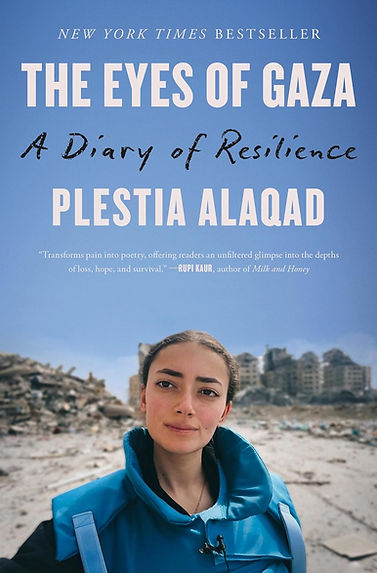
The Eyes of Gaza: A Diary of Resilience
Plestia Alaqad
North American edition with an exclusive afterword and photographs
INSTANT NEW YORK TIMES BESTSELLER | NATIONAL INDIE BESTSELLER | BOSTON GLOBE BESTSELLER | SAN FRANCISCO CHRONICLE BESTSELLER
In early October 2023, Palestinian Plestia Alaqad was a recent university graduate dreaming of a career as a journalist. But by the end of November, her homeland was unrecognizable—and she was broadcasting videos of violence and destruction to millions online, known across the world as "The Eyes of Gaza."
A series of diary extracts from the weeks following October 7, The Eyes of Gaza is a gutting, on-the-ground record of the turmoil and destruction endured by the men, women, and children of Palestine. As Alaqad flees from neighborhood to neighborhood, from hospital to hospital, she documents all she sees—the destruction of beloved homes, the waves of bombs, and most of all, the boundless bravery and generosity of her people—all the while trying to memorize the faces of those around her "so somebody will have known them before the end," wondering if, one day, her own journal will be discovered amidst the rubble.
A document of the indomitable Palestinian spirit, told through the voice of one ordinary young woman, The Eyes of Gaza is a tribute to Alaqad's beloved Gaza, a paean to the courage and endurance of Palestine, and a manifesto of hope for its future.

Special Honor: Transformative Systems Vision
Eco-Social Contracts for Sustainable and Just Futures
Patrick Huntjens, Najma Mohamed, Katja Hujo, Manisha Desai (Editors)
This groundbreaking open access volume introduces eco-social contracts as a bold and actionable vision for addressing the major, interconnected crises of our time—climate change, biodiversity loss, rising inequality, and the erosion of public trust and democratic legitimacy.
At its heart lies a fundamental realization that can no longer be ignored: the social contract has been broken for billions of people. As a result, the bonds between people, planet, and power must be rewoven.
Increasingly recognized by the UN, global assessments such as the IPBES Transformative Change Assessment, and by a growing international community of civil society leaders, youth movements, and NGOs, eco-social contracts call for renewed solidarity, systemic equity across generations and communities, inclusive governance, and a fundamental transformation of economic systems.
They challenge dominant economic paradigms and present a holistic and compelling alternative—one that rebalances our relationships with nature, institutions, and one another. This book captures that momentum, blending visionary thinking and grounded inspiration with hard-won lessons on unlocking and mobilising collective agency.
Rooted in diverse knowledge systems—from Indigenous cosmologies and feminist and care-based economics to regenerative development and post-growth thought—it brings together contributions from leading scholars, practitioners, artists, and activists across the globe. Bridging theory and practice, it offers vital insights into how regenerative, inclusive, and just futures can be co-created.
For changemakers, students, and all those seeking hope, direction, and clarity in a time of global uncertainty, this book is both a call to action and a guide for transformation—inviting readers to imagine and co-create sustainable and just futures our hearts and minds know are possible.
Selected Endorsements
Inger Andersen – Executive Director, UNEP: “This volume is a progressive and constructive contribution to building societies in harmony with nature.”
Mary Robinson – The Elders, and Former President of Ireland and UN High Commissioner: “This book makes clear that a new eco-social contract must be built on structural justice, intergenerational equity, and inclusive governance.”
Jayati Ghosh - Club of Rome, and UN High-Level Advisory Board on Economic and Social Affairs: “An incredibly timely and significant book that could not be more relevant for our current planetary emergency. Some light in the seeming darkness!”
Kumi Naidoo – President, Fossil Fuel Non-Proliferation Treaty Initiative: “This book convincingly shows why and how we must transition from systems that devalue life to economies that cherish well-being and shared prosperity.”
Karen O’Brien – Co-Chair, IPBES Transformative Change Assessment: “This book shows how we can recognize ourselves as agents of change. When we do, new realities become thinkable and actionable.”
Daan Zieren, Chair Youth Climate Movement (The Netherlands), part of the We Are Tomorrow Global Partnership (WAT-GP): “Young people feel the urgency of the climate crisis, but they lack the perspective of a structural solution. For a shared vision of the future, we need new forms of involvement. The eco-social contract offers an inspiring example of how we can build a sustainable future together."

Special Honor: Social Justice Impact
Without Fear: Black Women and the Making of Human Rights
Keisha N. Blain
Longlisted for the 2026 Andrew Carnegie Medal for Excellence in Nonfiction
One of Essence's "7 Political Books By Black Women Authors To Read Now" • A Library Journal Best Book of the Year • One of Bookbub's Best Nonfiction of 2025 • One of the African American Intellectual History Society's Best Black History Books of 2025
“Without Fear tells the stories of Black women who, like Deborah in the Bible, have engaged in social justice agitation, refusing to simply suffer by engaging in the redemptive work of challenging injustice while in the midst of it. Each of us can and must learn from these women if we are to reconstruct America and build a just world.” ―Reverend Dr. William J. Barber II, coauthor of White Poverty
Even before they were recognized as citizens of the United States, Black women understood that the fights for civil and human rights were inseparable. Over the course of two hundred years, they were at the forefront of national and international movements for social change, weaving connections between their own and others’ freedom struggles around the world.
Without Fear tells how, during American history, Black women made humans rights theirs: from worldwide travel and public advocacy in the global Black press to their work for the United Nations, they courageously and effectively moved human rights beyond an esoteric concept to an active, organizing principle. Acclaimed historian Keisha N. Blain tells the story of these women―from the well-known, like Ida B. Wells, Madam C. J. Walker, and Lena Horne, to those who are still less known, including Pearl Sherrod, Aretha McKinley, and Marguerite Cartwright. Blain captures human rights thinking and activism from the ground up with Black women at the center, working outside the traditional halls of power.
By shouldering intersecting forms of oppression―including racism, sexism, and classism―Black women have long been in a unique position to fight for freedom and dignity. Without Fear is an account of their aspirations, strategies, and struggles to pioneer a human rights approach to combating systems of injustice.
8 pages of illustrations

Special Honor: Investigative Excellence
Waste Wars: The Wild Afterlife of Your Trash
Alexander Clapp
A globe-trotting work of relentless investigative reporting, this is the first major book to expose the catastrophic reality of the multi-billion-dollar global garbage trade.
Dumps and landfills around the world are overflowing. Disputes about what to do with the millions of tons of garbage generated every day have given rise to waste wars waged almost everywhere you look. Some are border skirmishes. Others hustle trash across thousands of miles and multiple oceans. But no matter the scale, one thing is true about almost all of them: few people have any idea they're happening.
Journalist Alexander Clapp spent two years roaming five continents to report deep inside the world of Javanese recycling gangsters, cruise ship dismantlers in the Aegean, Tanzanian plastic pickers, whistle-blowing environmentalists throughout the jungles of Guatemala, and a community of Ghanaian boys who burn Western cellphones and televisions for cents an hour, to tell readers what he has figured out: While some trash gets tossed onto roadsides or buried underground, much of it actually lives a secret hot potato second life, getting shipped, sold, re-sold, or smuggled from one country to another, often with devastating consequences for the poorest nations of the world.
Waste Wars is a jaw-dropping exposé of how and why, for the last forty years, our garbage — the stuff we deem so worthless we think nothing of throwing it away — has spawned a massive, globe-spanning, multi-billion-dollar economy, one that offloads our consumption footprints onto distant continents, pristine landscapes, and unsuspecting populations. If the handling of our trash reveals deeper truths about our Western society, what does the globalized business of garbage say about our world today? And what does it say about us?

Special Honor: Ecological Imagination & Design
Lo—TEK. Water. A Field Guide for TEKnology
Julia Watson
Plunge into the ancestral water wisdom that could reshape all our futures. This spell-binding book reveals how Indigenous innovations—like floating farms, tidal fish traps, and aquifer recharge systems—have sustained civilizations for millennia by working with nature, not against it. Far from relics, these systems offer dynamic, adaptable solutions for the climate crisis of today.Structured to bridge past and future, the author Julia Watson dissolves the divide between technology and ecology, between ancestral wisdom and digital innovation.
The TEKnological Renaissance it celebrates redefines water as an intelligent force that can shape resilient cities and landscapes. Aquatic infrastructure is reframed—from extractive and industrial into regenerative and evolving—designed to sustain life for generations. Co-authored with Indigenous knowledge-keepers and with a foreword by Dr. Lyla June Johnson (Diné/Tsétsehést?hese), this captivating read investigates traditional hydrological technologies across diverse ecosystems, from salty coastal reefs to freshwater wetlands. Discover Mexico’s chinampas, China’s dike-ponds, Bangladesh’s floating farms and Micronesia’s tidal traps.
Shifting focus from the past to the present and future, it also showcases 22 groundbreaking contemporary TEK projects—including Peru’s reed-insulated housing, Thailand’s terraced rooftop farms, and China’s Sponge Cities—proving TEK continues to drive transformative design. This is both a field guide and a manifesto: a call to architects, planners, and communities to design with water’s elemental intelligence and build future worlds that are rooted in resilience.

Special Honor: Fiction for Global Consciousness
Extinction Capital of the World
Mariah Rigg
A Recommended Read from: Vulture * Oprah Daily * Our Culture * LitHub * Debutiful * LGBTQ Reads * Alta Journal * Autostraddle * BookRiot
Magnetic, haunting, and tender, Extinction Capital of the World is a stunning portrait of Hawai’i—and a powerful meditation on family, queer love, and community amid imperialism and environmental collapse.
In ten vibrant, affecting stories, Mariah Rigg immerses readers in contemporary Hawai’i. By turns heartbreaking and hopeful, these stories of love, longing, and grief are fierce dispatches from a state haunted by the specter of colonization, a precious biome under constant threat.
An older man grapples with the American-weapons research conducted on a neighboring island that reverberates through his entire life. A pregnant woman seeks belonging while poaching flowers in the rainforest with her partner’s mother. Two teenage girls find love during a summer spent on Midway Atoll. A young woman returns home to O’ahu following a breakup and reconnects with her estranged father and the island itself.
Linked by both place and character, Rigg’s stories illuminate the exotification and commodification of Hawai’i in the American mythos. Extinction Capital of the World is an environmental love letter to the Hawaiian Islands and an indelible portrayal of the people who inhabit them—marking the arrival of an exciting new voice in contemporary fiction.

Special Honor: Cultural Heritage & Literary Preservation
Edmund Spenser's The Faerie Queene, a Prose Rendering: A Text-Faithful Translation of the 1590s Epic Poem
Rebecca K. Reynolds (Author); Justin Gerard (Illustrator)
Welcome to Edmund Spenser’s 1590s epic poem, The Faerie Queene. This richly illustrated, text-faithful, line-by-line prose rendering transports modern readers into a vast narrative tapestry. Knights traverse diverse fantastical landscapes including the shadowy depths of an enchanted forest, a treacherous underwater lair, a mysterious subterranean kingdom, and the deadly Bower of Bliss.Through these realms stride Spenser’s unforgettable knights―brave yet fallible, powerful yet vulnerable―as they confront ferocious monsters, cunning wizards, beguiling enchantresses, and even encounter young Prince Arthur, who wanders Faerie Land consumed by his passion for Gloriana, the elusive Faerie Queene.Many have attempted to read Spenser’s original masterpiece only to retreat, daunted by language that was deliberately archaic even in Elizabethan times. Classical educator Rebecca K. Reynolds bridges this gap, crafting a prose adaptation that gradually introduces more of Spenser’s distinctive vocabulary and diction. By the final volume, readers will find themselves prepared to engage directly with Spenser’s original text with confidence and delight.For four hundred years, Spenser’s realm has captivated powerful creative minds, igniting literary movements and inspiring countless works. So, take a few first steps with us through the mist-shrouded edges of Faerie Land. As C.S. Lewis wisely observed: “The Faerie Queene never loses a reader it has once gained... Once you have become an inhabitant of its world, being tired of it is like being tired of London, or of life.”